
Curriculum Programs
Mount Ridley Prep – 12 College is committed to providing a challenging, flexible and comprehensive curriculum, meeting the needs of our students, whilst maximising their learning opportunities. Personal development and thinking skills are promoted within classroom learning and students are supported to become independent learners. Teaching and Learning at Mount Ridley Prep – 12 College centres around the Victorian Curriculum 2.0. The Victorian Curriculum 2.0 is the Foundation to Year 10 curriculum that provides a single, coherent and comprehensive set of prescribed content and common achievement standards, which schools use to plan student learning programs, assess student progress and report to parents. The curriculum is the common set of knowledge and skills required by students for life-long learning, social development and active and informed citizenship. The Victorian Curriculum 2.0 F–10 incorporates the Australian Curriculum and reflects Victorian priorities and standards.
The Teaching and Learning program at Mount Ridley Prep – 12 College incorporates elements such as:
- Catering for students of all abilities and allowing students to be challenged, in order to achieve ongoing personal success;
- Striving for engaging and rigorous learning that genuinely embraces and models life-long learning by all members of the College community;
- Encouraging active involvement in their community;
- Providing an educational experience that is focused on clear goals and developing learners who are motivated, engaged and take responsibility for their learning;
- Using evidence-based teaching, targeted at improving each student’s literacy, numeracy and problem solving skills;
- Developing personal and inter-personal skills to allow them to deal with the challenges they will encounter as global citizens;
- Cooperative learning and collaborative teaching;
- Integrated and disciplinary curricula that is negotiated, relevant and challenging;
- Opportunities to complete rich and dynamic tasks that engage our students in reflective and critical thinking;
- Emphasis on strong teacher-student and student-student relationships through extended contact with a small number of teachers as members of a mini-school;
- Developing a range of opportunities for parents to be involved in their child’s education and be informed about their level of achievement; and
- Seamlessly integrating the use of technology in delivering an innovative and engaging teaching and learning program.
Our teaching practice is built on a value system that incorporates our core values of respect and tolerance, honesty and trust, personal success and responsibility that is embedded into the school culture. The knowledge, skills and conceptual understandings that underpin the learning outcomes are carefully scaffolded by genuine and trusting relationships harnessed through a range of personal and social development programs and a deeper understanding in restorative practices which value diversity and individuality.
Effective teaching is the single biggest determinant of student improvement in the school. Teachers not only have a direct impact on student achievement but also student engagement and motivation for learning. What teachers do in the classroom and how they interact with students is vital. Mount Ridley Prep – 12 College has a continuous focus on student learning with clearly articulated and implemented curriculum outlines and processes. The utilisation of flexible practices maximises the strengths of individual staff members as a collective whole. Differentiation of student learning tasks is imperative, and the allocation of student groups and explicit programs is determined by accurate student data and team moderation. Approaches, groupings, intervention and extension are fluid and responsive, based on ongoing, real-time assessment of student growth in all areas. It is the intention of each team to maximise the use of the school facilities, in particular the usage of digital technologies and ICT resources. As part of the Teaching and Learning Framework and the HITS model, the demand for high expectations and the implementation of Higher Order Thinking skills and strategies from Prep to Year 12, across all domains lead to the achievement of improved student outcomes. Through the allocation of targeted Professional Development, access to immediate student data via Compass and Professional Learning Communities (PLC), Mount Ridley Prep – 12 College has developed a shared understanding of best practices that improve teaching strategies, teacher capacity and what reduces the barriers to learning.
Feedback to students is ongoing. It is the focal point for continuous learning. Teachers provide frequent, constructive and instructional feedback to students. Involving students in discussion centred around rubrics, test results, learning tasks and goal setting bridges the gap between current and desired student outcomes. At Mount Ridley Prep – 12 College we endeavour to provide a regular and convenient reporting system that is aimed at ensuring parents and carers are regularly informed of their child’s educational progress in a timely manner. Ongoing reporting is enabled through the completion of two Learning Tasks per term, 5-week cycles of Grade Point Average (GPA) which evaluates key learning behaviours relating to effort and behaviour and Summary Reports are provided at the end of Terms 2 and 4. WeShare Parent Teacher are provided at the end of Terms 1 and 3.
Mount Ridley College Curriculum Framework
Early Years Mini School

Reading and Viewing
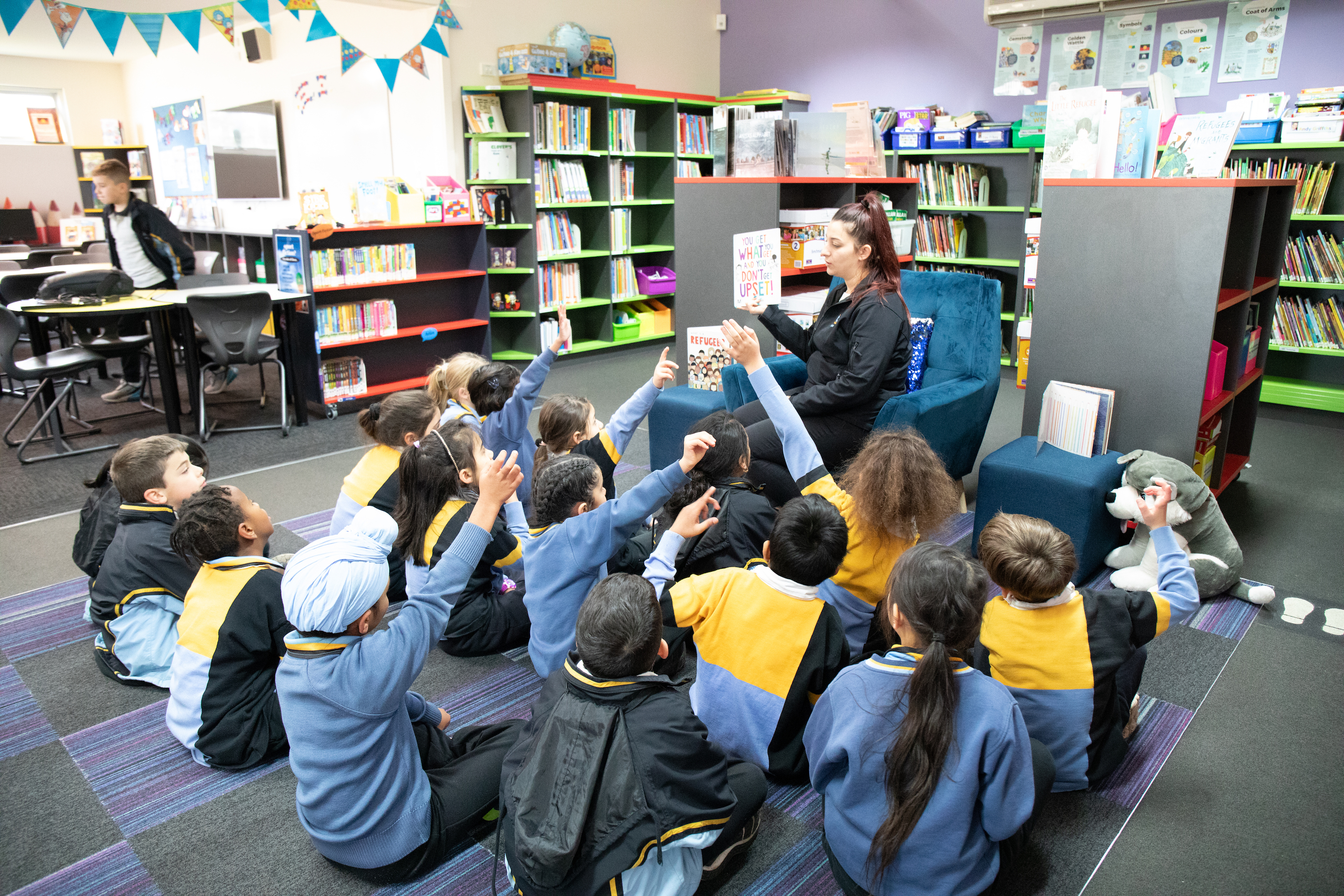
Literacy is at the heart of students’ ability to learn and succeed in school and beyond. In the Early Years students take part in reading, writing and spelling sessions on a daily basis. Key features of the Early Years literacy program include wider reading, author study, speaking and listening, smart spelling and writing genre practice. Every staff member has a commitment to extending literacy across the curriculum. Early Years students participate in a weekly library program, where they borrow regularly and learn library skills to further develop their knowledge.
Little Learners Love Literacy at Mount Ridley College (Prep- Yr 2)
At our college, we are committed to giving every child the strongest possible start in learning to read, write and spell with confidence.
That’s why we use Little Learners Love Literacy® (LLLL) – as an explicit, sequential and evidence‑based approach designed to support children as they move from beginner readers to confident, fluent learners. LLLL focuses on phonemic awareness, systematic phonics, handwriting, reading fluency, vocabulary and comprehension. This structured approach ensures children build their skills step‑by‑step. LLLL is taught in a clear sequence from Prep to Year 2, allowing students to practise and master new skills at each stage. They learn how letters and sounds work together and how to decode words, empowering them to “lift the squiggles off the page” and grow as independent readers and writers. A key strength of Little Learners Love Literacy is its engaging, multisensory learning experience, which includes songs, games, puppetry, stories and hands‑on activities. These resources build confidence and make early literacy enjoyable and meaningful for young learners. Families may also notice their children bringing home decodable books, which are carefully designed to match what students have been explicitly taught. These books support reading success, fluency and comprehension, and help children experience the joy of reading from the very beginning. To ensure high‑quality teaching, our staff participate in ongoing professional learning and use live data to track student progress and tailor instruction. This collaborative, reflective approach strengthens outcomes for all students.
Writing
Students participate in daily writing activities. In Prep – Year 2 students are supported to become independent writers. Approaches used to support students include Modelled Writing, Shared Writing, Mirrored Writing and Guided Writing. In Years 3 and 4, students learn the essential structures of different genres and their appropriate use, including Information Reports, Narratives and Persuasive Texts. Whilst teachers work closely with students and help them edit their work, they also aim to have students take responsibility for their own writing. Students in Years 1 to 4 have a weekly session of Writers Notebook. Writers Notebook encourages students to write freely, to take in the world around them and document their daily lives and provides an easy, informal way to start thinking about new topics and ideas. These notebooks are a great place to store favourite quotes, random facts, dreams, ideas for the future and it allows students to take ownership of their writing. Handwriting is a continual process of development. Students are taught to develop a neat handwriting style with a focus on the correct pencil grip and correct letter formation, using the Victorian Cursive Script. Grammar, punctuation and spelling are also important aspects of writing and are taught explicitly as part of the writing program.
Numeracy
The Numeracy classroom is a place where students become competent users of the language of mathematics through learning experiences that are challenging and engaging. Our students continuously work toward building a sound foundation of mathematical skills and understandings. They are encouraged and supported to use their knowledge for problem solving and making sense of the world they live in. We encourage and support our students to develop a rich understanding of mathematical skills and understandings by teaching in a relevant, realistic context. All Numeracy classroom programs at Mount Ridley Prep - 12 College follow a lesson structure of a warmup, an introduction, student learning activity and a reflection. Differentiation is a key component of our numeracy program. Teachers look at the needs of their students and work with them to scaffold their learning. Students utilise a wide range of resources to assist them in developing understandings and skills. At Mount Ridley Prep - 12 College we believe in applying mathematical skills to real-world tasks to support students learning. At Mount Ridley Prep - 12 College students in Prep to Year 6 are able to access Mathletics which is an interactive website with a range of math games and activities. Teachers can personalise learning by setting tasks that meet the needs of all children and can monitor their progress as tasks are completed.
Inquiry
At Mount Ridley Prep – 12 College we also investigate the world around us through the implementation of inquiry learning units. These units are based on the key content outlined in the Victorian Curriculum and concepts, skills and content are explored in the learning areas of Humanities, Science, Technologies and the general capabilities. Each term students are immersed in a new Inquiry topic for example Simple Machines, Community and Sustainability. Each unit is designed around a broad focus question or statement to promote high order thinking and encourage students to pose questions.
Specialist AreasStudents in Prep to Year 4 undertake studies in: · Health and Physical Education · Languages (Italian and Japanese): 6 months of each · Oral Language Program (Prep only) · Perceptual Motor Program (Prep only) · Performing Arts · Visual Arts |
LibraryStudents in Prep to Year 6 participate in a fortnightly library program. This program works alongside the ‘Read 2 Succeed’ model and students learn to choose good fit books, book care, learn how to access the library Dewey system and to borrow regularly. |
Junior Years Mini School
This period of schooling, referred to as the Junior Years, coincides with early adolescence. This is a time that represents an important stage in a student’s development. At Mount Ridley Prep – 12 College, we recognise that these are the years when experiencing positive relationships and being genuinely engaged in learning and developing high self-esteem have a major and lasting impact on each young person. The teaching and learning program for Junior Years Mini School students is based on the understanding that all individuals have distinct learning styles that influence their ability to learn, process, practise and retain new and different information. The Junior Years Mini School program is specifically designed to bridge the social and academic gap between traditional primary school and secondary schools.
Core Subjects
Our core subjects of Mathematics, Science, English and Humanities utilise Oxford Textbooks from Year 7 -10. These can be purchased as a bundle through Campion Education.
Mathematics and Science
The traditional subjects of Mathematics and Science are closely linked in the Junior Years Mini School. Mathematics and Science are explicitly taught separately, however Mount Ridley students are encouraged to make connections and links across these two areas of learning. Numeracy competency is both a daily essential and an enriching asset. Junior Years students engage in a range of approaches to the learning and doing of Mathematics that develop their understanding of and fluency with concepts, procedures and processes by making connections, reasoning, problem-solving and practice. Proficiency in mathematics enables students to respond to familiar and unfamiliar situations by employing mathematical strategies to make informed decisions and solve problems efficiently. Students in Year 7 and 8 utlilise the online learning platform Atomi in Mathematics that specialises in curriculum-aligned video lessons, interactive quizzes and revision tools for secondary school students and teachers. It provides bite-sized content designed to improve engagement for students. In Science, students develop a broader view of scientific knowledge, which includes different perspectives and worldviews, consideration of socio-scientific issues, and the importance of communicating scientific knowledge. Learning activities in Mathematics and Science are designed to incorporate a hands-on approach and provide opportunities to apply knowledge to real life situations.
Health and Physical Education
Health and Physical Education aims to develop the knowledge, understanding and skills to enable students to:
- access, evaluate and synthesise information to take positive action to protect, enhance and advocate for their own and others’ health, wellbeing, safety and physical activity participation across their lifespan.
- develop and use personal, behavioural, social and cognitive skills and strategies to promote a sense of personal identity and wellbeing and to build and manage respectful relationships.
- acquire, apply and evaluate movement skills, concepts and strategies to respond confidently, competently and creatively in a variety of physical activity contexts and settings.
- engage in and enjoy regular movement-based learning experiences and understand and appreciate their significance to personal, social, cultural, environmental and health practices and outcomes.
- analyse how varied and changing personal and contextual factors shape understanding of, and opportunities for, health and physical activity locally, regionally and globally.
Languages
In Years 5 & 6, students study one semester each of Italian and Japanese. This enables them to gain knowledge and appreciation of these languages and cultures. In Year 7, students then select one of these languages, which they continue to study until Year 9.
Specialist Subjects
Junior Years Mini School students also study elective subjects that aim to provide them with a wide range of learning experiences. These subjects are one semester in duration and focus on the learning areas of The Arts and Design, Creativity and Technology. The elective subjects undertaken by students in the Junior Years Mini School are:
|
Years 5 & 6 · Art · Performing Art · Food Technology · Design and Technology |
Year 7 · Performing Art · Design and Technology
|
Middle Years Mini School
The Middle Years curriculum provides our students with opportunities to:
- explore individual and group identities
- develop relationships with peers and adults in an environment which supports diversity, access and inclusion
- negotiate and collaborate with each other in a variety of complex and challenging real world contexts
- develop organisational and inquiry skills.
During the Middle Years, students undertake year-long programs in the subject areas of Mathematics, English, Science, Humanities, Physical Education and Health, and Languages, (Italian or Japanese).
Our core subjects of Mathematics, Science, English and Humanities utilise Oxford Textbooks from Years 7 -10. These can be purchased as a bundle through Campion Education.
The elective semester subjects undertaken by students in the Middle Years Mini School are:
|
Year 8 · Art and Design · Design and Technology |
Year 9 · Food Studies · Photography and Media
|
Health and Physical Education
Health and Physical Education aims to develop the knowledge, understanding and skills to enable students to:
- access, evaluate and synthesise information to take positive action to protect, enhance and advocate for their own and others’ health, wellbeing, safety and physical activity participation across their lifespan.
- develop and use personal, behavioural, social and cognitive skills and strategies to promote a sense of personal identity and wellbeing and to build and manage respectful relationships.
- acquire, apply and evaluate movement skills, concepts and strategies to respond confidently, competently and creatively in a variety of physical activity contexts and settings.
- engage in and enjoy regular movement-based learning experiences and understand and appreciate their significance to personal, social, cultural, environmental and health practices and outcomes.
- analyse how varied and changing personal and contextual factors shape understanding of, and opportunities for, health and physical activity locally, regionally and globally.
The Middle Years is the opportunity for students to ‘taste test’ and determine where their strengths, interests and passion lies before entering the Senior School and selecting their own subject pathway. The teaching and learning program continues to be supported by the BYO device program at the College.
The Middle Years Certificate is a two-year program beginning at Year 8 and concluding in Year 9. Over the course of the two years, students are invited and provided opportunities to participate in additional activities such as excursions, incursions, and leadership opportunities. These activities are recorded and acknowledged at the end of Year 9 when students are awarded their Completion Certificate. The certificate evaluates three domains – Academic, Global Citizen and Extra-Curricular and contains five different levels of achievement. All students receive a certificate reflecting their level of achievement as well as a personalised letter of achievement signed by the College Principal to use for potential future employment.
Senior Years Mini School

The Senior School endeavours to promote an adult style learning environment that is appropriate for 15–18 year-olds. Students in our Senior School will experience a diverse range of teaching styles appropriate with the pedagogical content knowledge that is intrinsic to the subject of study. Senior School students will also be expected to participate in a wide variety of learning and co-curricular experiences. All courses within the Senior School require students to develop independent working, learning and study skills. The increased focus on independent working, learning and study skills in the Senior School is considered to be necessary for establishing a successful transition and pathway to tertiary education or to the world of employment. The aim of the Senior School program is to provide students with comprehensive breadth and depth of curriculum choices. In addition, we provide Senior School students with appropriately challenging and rigorous learning experiences that ensure their development of key concepts, knowledge, skills and capabilities to achieve excellence through endeavour.
Year 10 Program
The structure of the Year 10 program at Mount Ridley Prep – 12 College has been designed to expose students to a wide range of learning areas and learning experiences. It allows them to make informed choices around their areas of interest. Year 10 is a critical time in a student’s schooling journey. Year 10 provides access to a number of innovative and engaging units, which are preparation for the rigours of the VCE (Victorian Certificate of Education), VCE VM (Victorian Certificate of Education Vocational Major) as well as workplace and further training options. The College has an extensive range of units on offer for the post compulsory years of schooling at Mount Ridley P-12 College.
Students continue to build on the strong teaching and learning foundations set in Year 9, with a wide range of subject choices offered to our students at Year 10. Flexibility and the ability to pursue a wide range of both academic and vocational interests are the main features of the Year 10 Teaching and Learning Program. Opportunities to undertake selected VCE subjects are provided, as well as preparing students for their career choices and future pathways. A range of compulsory and optional subject choices are also provided, including access to TAFE and other on the job training opportunities. Core numeracy and literacy skills and the ability to communicate confidently, capably and critically are a major focus as students continue to engage with the wider community and prepare for future studies and pathways.
Years 11 and 12 Program
Mount Ridley Prep – 12 College offers a broad and extensive range of VCE subjects that allow students to access their individual pathways involving further tertiary studies, apprenticeships, or employment. The VCE Vocational Major (VCE VM) has replaced the Victorian Certificate of Applied Learning (VCAL) at the intermediate and senior levels. The VCE Vocational Major is a 2-year vocational and applied learning program that enables transitions into apprenticeships, traineeships, further education and training and university (via non-ATAR pathways). It employs a more diverse range of assessment strategies rather than exams, alleviating some of the pressure that students face when completing the VCE.
© Mount Ridley College